01
Modern client experience
Replace the aging client experience with a fast, modern, maintainable one.

Case study
How Huboxt rewrote a community print-publishing platform from a hard-coded Node.js/AngularJS stack onto FastAPI and Next.js — without breaking the existing database or admin tooling.
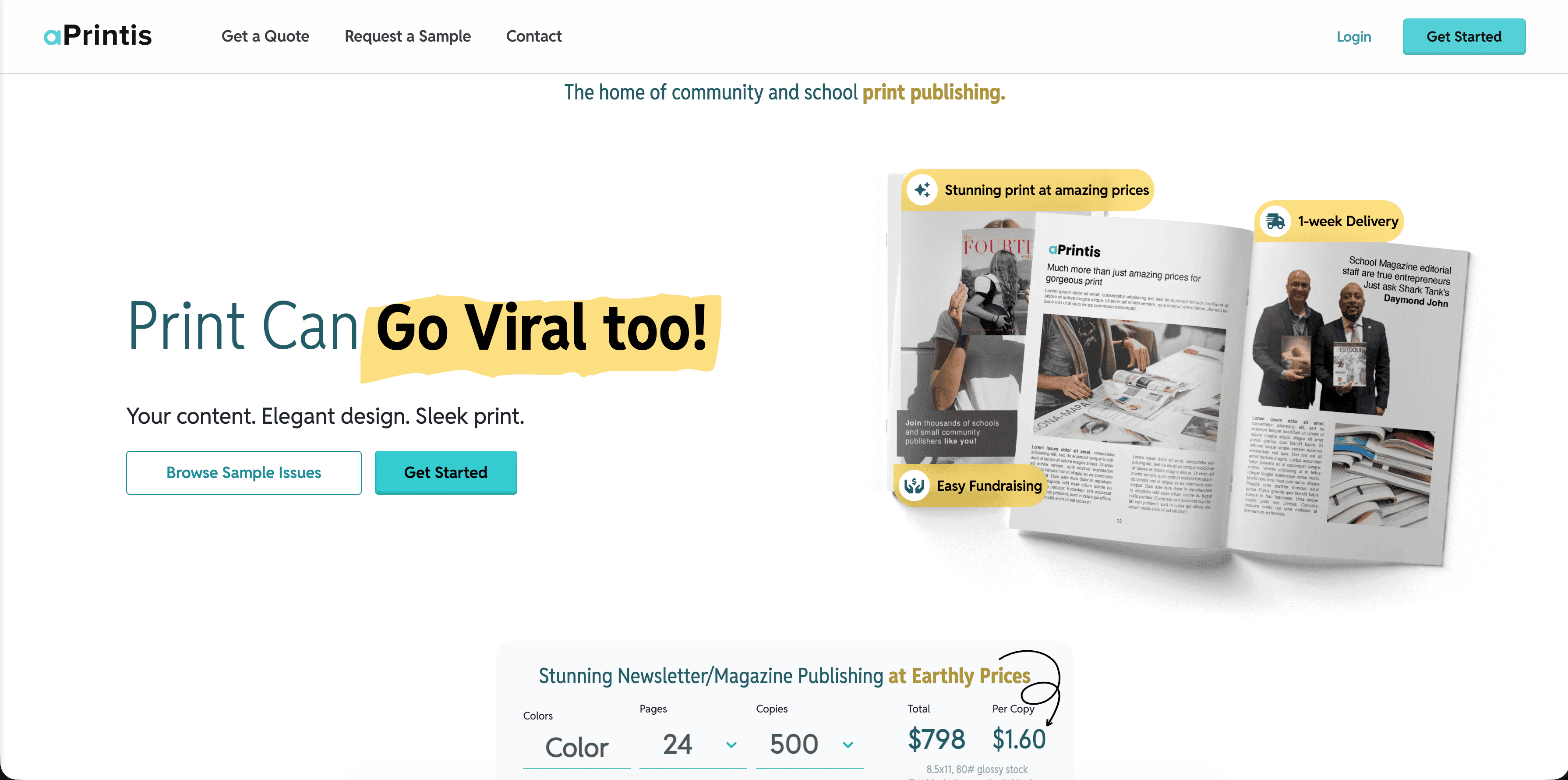
aPrintis is a print-publishing platform for schools, nonprofits, churches, clubs, and small communities — magazines and newsletters at roughly $1 a copy, plus community fundraising and content collaboration. Some publications have been printing with them for over a decade.
The application was built on Node.js with LoopBack 3 and an Angular 2 front end. Both were well past their prime: little coherent architecture, values and logic hard-coded throughout, and a front end that was difficult to extend or maintain. Every new change carried risk, and the user experience no longer matched the quality of the printed product aPrintis is known for.
The brief was demanding: modernize the platform and the customer-facing experience without a long, risky, big-bang migration, and without disrupting the data and back-office tooling the business already depended on every day.
01
Replace the aging client experience with a fast, modern, maintainable one.
02
Move off the legacy framework stack onto something the team could build on for years.
03
Keep the existing production data intact and avoid a painful migration.
04
Ship continuously and visibly, so the client could see and steer progress week to week.
Rather than tear everything down at once, we scoped the rewrite where it mattered most: a full overhaul of the client-facing side while the existing admin functionality kept running from the original system. We built the new FastAPI back end against the existing production database, worked in one-week demo-driven sprints, and validated each increment internally before it shipped.
01
Rework the client-facing side completely and keep the existing admin functionality running from the original system — removing a huge amount of risk and scope while the back office staff relied on kept working untouched.
02
Built the new FastAPI back end to talk to the existing production database directly — eliminating migration bugs and letting the new system and legacy admin tooling share the same source of truth from day one.
03
Every sprint across the three weeks ended in a working demo — keeping the client in the loop and turning a fast timeline into a series of visible, verifiable steps.
04
Each increment was validated internally so what we showed — and handed over — actually worked, not just a slideware promise.
A focused client-side re-platform that modernized the customer experience while the business kept running on the same data and admin tooling.
FastAPI back end
A new API replacing LoopBack 3 — cleaner, faster, typed, and far easier to maintain and extend, while reading and writing the same existing database.
Next.js front end
A modern, performant, maintainable customer experience replacing the Angular 2 client — built on a framework with a long runway ahead of it.
New landing page
A brand-new marketing front door to present aPrintis the way its print product deserves — the same modern quality as the application behind it.
Legacy admin coexistence
Seamless coexistence with the legacy admin system, which continued to run back-office workflows against the shared database with no rework required.
01
A full client-side re-platform from an outdated, hard-coded stack to a modern FastAPI + Next.js foundation.
02
No disruption to operations — by building against the existing database and preserving legacy admin tooling, the business kept running throughout.
03
Structured architecture the team can build on, replacing ad-hoc, hard-coded logic they previously had to work around.
04
A customer experience and landing page that finally match the quality of the printed publications aPrintis produces.
05
Weekly demos meant the client always knew exactly where the project stood and could shape it as it went.
“The win here wasn't just the new stack — it was the strategy. By rewriting only the client side, integrating directly with the existing database, and shipping in demo-driven weekly sprints, Huboxt turned what could have been a months-long, high-risk rewrite into a focused three-week engagement that left the business running the whole time.”
Let's talk
Contact us if you have any projects in mind
Tell us about your idea, expected budget, and timeline. We usually reply within one business day.