01
Bulk by default
Let customers submit documents and addresses in bulk, with infrastructure that stays smooth as volume and user count grow.

Case study
How Huboxt built a high-load digital-mail platform from a USPS API integration up to a full turnkey product — sending letters, certified mail, checks and international post through USPS, with OCR ingestion, an Enterprise API, Stripe billing and a print-shop pipeline.
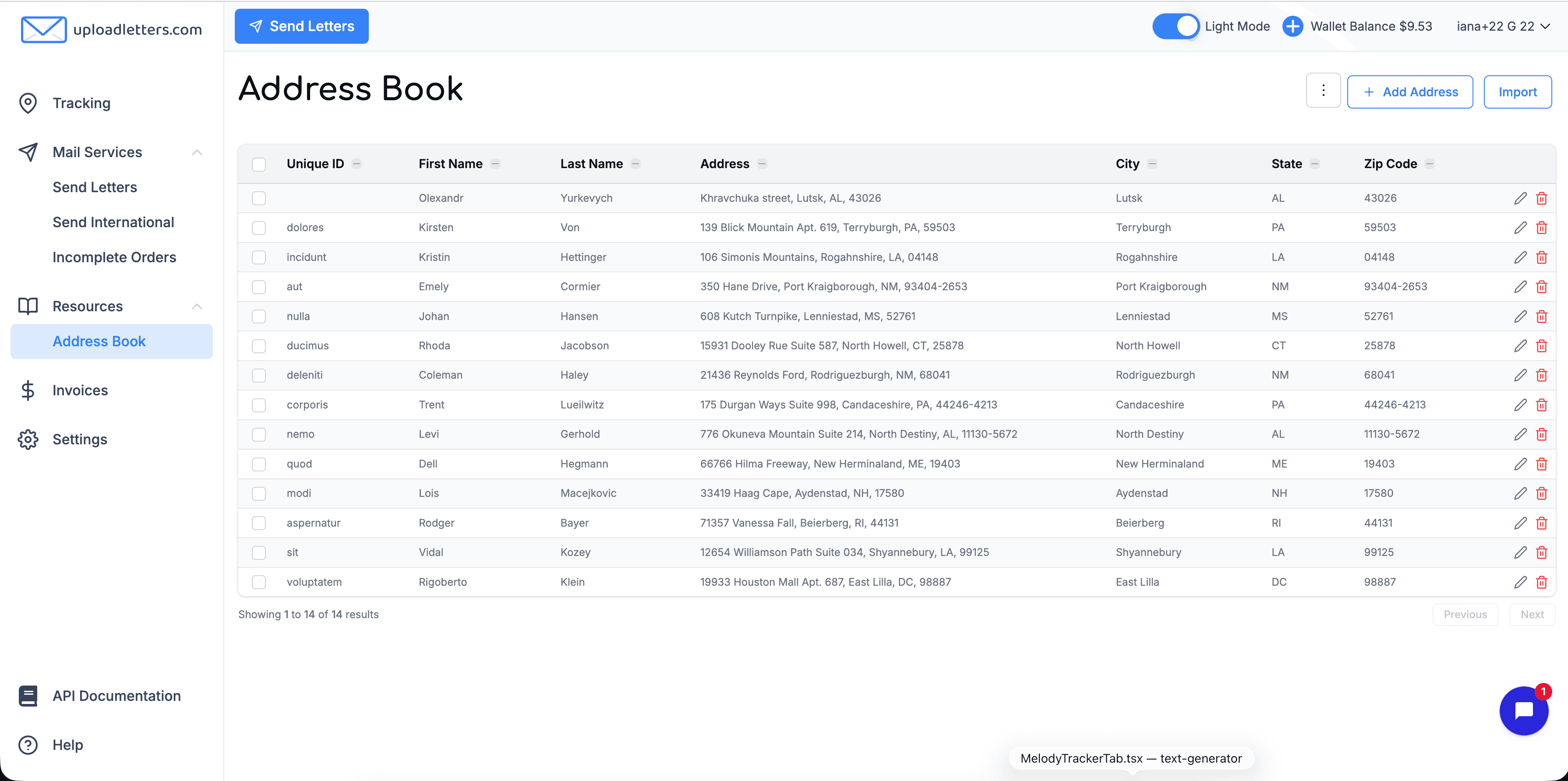
Upload Letters is a Texas-based startup that lets you send First-Class, Certified and Priority Mail digitally: upload a PDF, and the recipient gets it as physical mail delivered by USPS. Traditional mail is still everywhere government agencies, financial institutions, law firms and small businesses operate — and it's still slow, manual and painful to send at volume.
Making that real meant solving three hard problems at once. It had to scale — core customers send thousands of letters a day, so ingestion and infrastructure had to stay stable under heavy, bursty load. It had to be compliant and secure, meeting USPS's strict rules while protecting sensitive, private correspondence. And it had to be a pleasure to use, with modern auth, flexible billing, and several different ways to get mail into the system.
The toughest part lived at the edges: USPS itself. The integration had to satisfy USPS's strict terms of use and XML-only request standards, against fairly basic documentation, limited support, and no SDK or example code to lean on.
01
Let customers submit documents and addresses in bulk, with infrastructure that stays smooth as volume and user count grow.
02
Comply with USPS regulations and protect all the private, sensitive data flowing through the system.
03
An intuitive interface, fast and convenient billing, Google and Microsoft OAuth, tiered account levels, and multiple ways to submit mail.
The partnership began as a focused USPS API integration — proving the hardest part first — and grew into a full turnkey build once that foundation was solid. We chose microservices from day one, matched each workload to the right stack, and ran everything on containerized AWS with Grafana monitoring and alerting.
01
Build the USPS API integration layer first — sending mail, tracking delivery, return receipts, barcodes and per-page print marks — all within XML-only, tightly-governed standards. Getting that right is what made everything above it possible.
02
Rather than retrofit scalability later, we started with a microservice architecture so the platform could stay overload-resilient under bursty, high-volume submissions.
03
React for the front end; Laravel + Laravel Nova for fast back-end and admin development; Golang for the high-throughput Enterprise API; Python for the OCR engine — each choice made for the specific workload.
04
The platform runs on AWS ECS, with Grafana monitoring and alerting so issues are caught and acted on before they reach customers.
A full turnkey digital-mail platform — from accounts and USPS delivery to OCR, Enterprise API, billing, and the print-shop pipeline.
Accounts, teams & access
User registration with Google and Microsoft OAuth (plus email), team management, and role-based access levels across the application.
The USPS engine
Sending across multiple mail classes — First-Class, Certified Mail, Certified Mail with Electronic Return Receipt, and Priority Mail — plus address verification, USPS tracking, return-receipt handling, barcode generation and international mailing.
Mailing checks
The ability to send physical checks alongside letters, which required an additional Stripe ACH bank-account-verification integration to confirm the underlying accounts.
Four ways to send
Mail can be submitted manually from the website, via OCR from scanned/paper sources, through an Enterprise API, or over SFTP — covering everyone from a one-off sender to an enterprise piping batches straight from their CRM.
The OCR killer feature
A high-performance OCR module that lets users upload huge PDF letter images, select an area on the first page, and have the system split it and build individual letters automatically. Benchmarked at 5,000 addresses scraped in 7.7 seconds.
Billing & custom pricing
Per-transaction balance and payments via Stripe, with custom pricing configurable per customer (the more you send, the cheaper each letter).
Admin & print-shop pipeline
An admin platform for managing users and content, integrated with a third-party print shop — handling letter images, barcode generation and USPS manifests end to end.
Company-level configuration
Configurable settings at the company level, spanning everything from SLAs to bank-account configuration, so the platform adapts to each organization's terms.
01
A scoped integration grew into a full turnkey platform — earned by delivering the hardest part (USPS) first and well.
02
A microservice architecture on AWS ECS designed for customers sending thousands of letters a day.
03
5,000 addresses parsed and split in 7.7 seconds — the feature that makes high-volume sending effortless for non-enterprise users.
04
Website, OCR, Enterprise API and SFTP in one product — serving individual senders and enterprise integrations alike.
05
Meeting USPS's strict standards, with Grafana monitoring and alerting keeping the platform healthy in production.
“Aside from providing superior products, their ability to genuinely interact on a personal level impresses us the most!”
“The strategy was to earn the big build by nailing the hard part first. Instead of pitching a turnkey platform up front, Huboxt started with the riskiest, least-documented piece — the USPS integration — and delivered it against strict, XML-only standards with no SDK to lean on. That trust turned a single integration into a full product: a scalable, compliant, multi-channel mailing platform with its own OCR engine, Enterprise API, billing and print-shop pipeline. The right tool for each job, microservices from the start, and real observability are what let it carry serious volume in production.”

Read the client's review on Clutch
Independent feedback from the team behind this project — verified on Clutch.
Let's talk
Contact us if you have any projects in mind
Tell us about your idea, expected budget, and timeline. We usually reply within one business day.